Fashion Retail in Japan
Japan’s apparel market grew again last year — but the rewards went overwhelmingly to the biggest players. The top 100 retailers now hold 71% of the market, and within specialty retail the top 10 alone control around a third: fashion retail in Japan is now, in effect, an oligopoly.
How big is Japan’s fashion market?
Total apparel and accessories sales reached ¥15.1 trillion in FY2024, up 2.7% after near-flat growth the year before (apparel alone: ¥12.1 trillion, up 2.9%). The headline conceals a structural shift: while the market inched forward, the top 100 apparel retailers grew 6.8% to a combined ¥8.56 trillion — taking their share to 70.9%, up 1.4 points in a single year. The gap is filled by the ongoing contraction and closure of smaller, regional and family-owned chains, and of wholesale-dependent specialty retailers.
Who leads Japanese fashion retail?
Uniqlo (Japan) leads with sales of ¥932 billion, followed by Shimamura (¥657 billion), Zozo (¥565 billion), and sister chain GU (¥319 billion, up 8.1%). The consistent outperformers since 2019 — Uniqlo, GU, Muji, Adastria, Pal Group, Shimamura, Nishimatsuya Chain and Workman — share national store networks and heavy investment in customer data, supply chains and store-brand ranges.
Both ends of the price spectrum are winning. Affordable casual chains (Shimamura, GU, Uniqlo, Muji, Workman) capture share through blanket coverage and price competitiveness, while premium lifestyle retailers and select shops thrive on wealthier urban spending: Mash Holdings has grown 2.3-fold in a decade and Baycrews 64%, both expanding into lifestyle categories well beyond fashion. Muji posted 14.9% growth as a “safe haven” brand for value-conscious consumers. Workman remains Japan’s most profitable clothing retailer, with a 17.8% operating margin and ten straight years of sales growth.
Who is losing?
Two formats are in structural decline. Suit specialists have lost 20% of combined sales over the past decade as workplace dress codes relax. Wholesale-dependent casual chains (Mac House, Right On and others) have fared worse, down roughly 50% over ten years as vertically integrated giants take share. Specialty store numbers overall have fallen for five straight years — more than 1,500 net closures — as leaders concentrate on fewer, larger, better stores and omnichannel investment.
What decides who wins?
- Location — the fastest-growing retailers are national chains or centred on Japan’s four major metropolitan areas; regional players struggle to overcome shrinking local customer bases regardless of quality.
- Scale and investment capacity — customer data analysis, supply chain optimisation, omnichannel and AI increasingly separate leaders from the rest.
- Value clarity — both cheap and premium outperform; the squeezed middle keeps losing share.
The full analysis: Japanese Fashion Retail
JapanConsuming’s fashion coverage is the complete dataset and analysis behind this overview — the Top 100 apparel retailer ranking, fastest-growing and most profitable operators, store opening/closure trends and market share by format. All reports are available to Enterprise subscribers of JapanConsuming.
In the report
- Complete Top 100 apparel retailer ranking with sales, growth and apparel share
- Fastest-growing retailers ranking across all formats
- Most profitable specialty apparel retailers, with margin analysis
- Store opening/closure trends by chain
- Market share by format, FY2006–2024

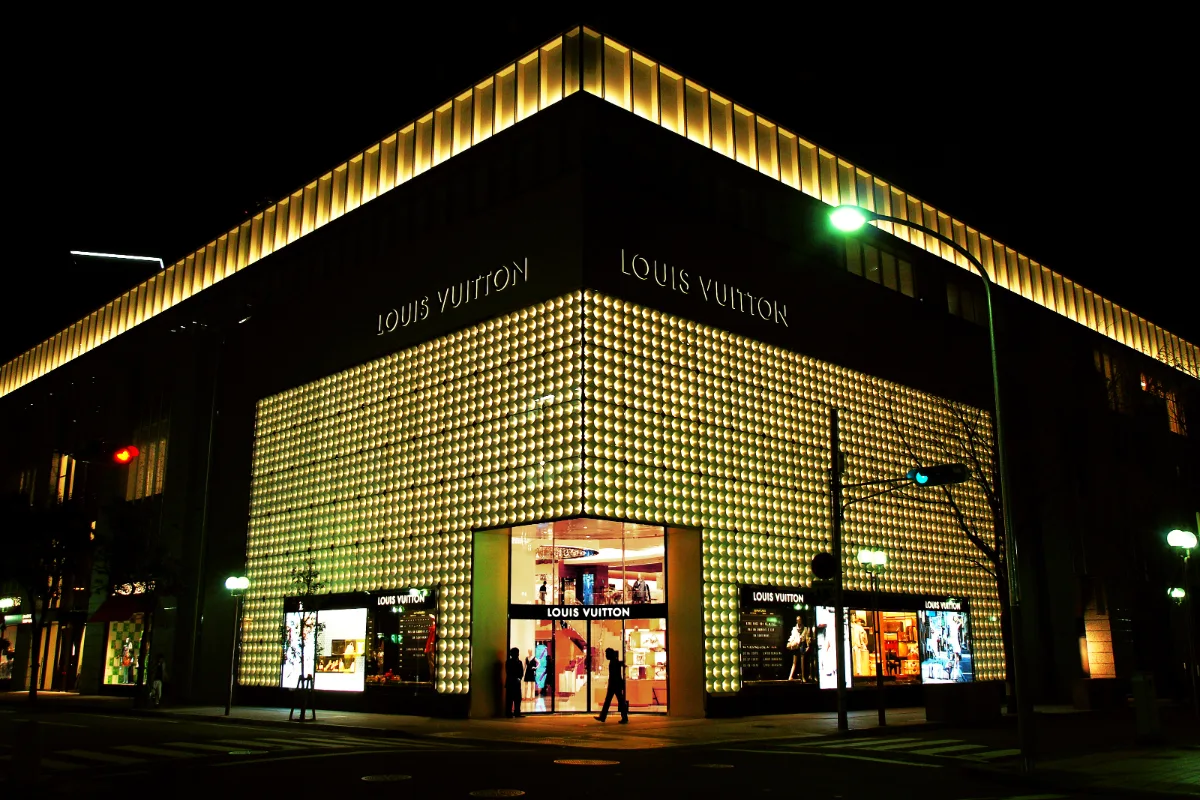
- Cover: Louis Vuitton Maison, Kobe — via Wikimedia Commons.