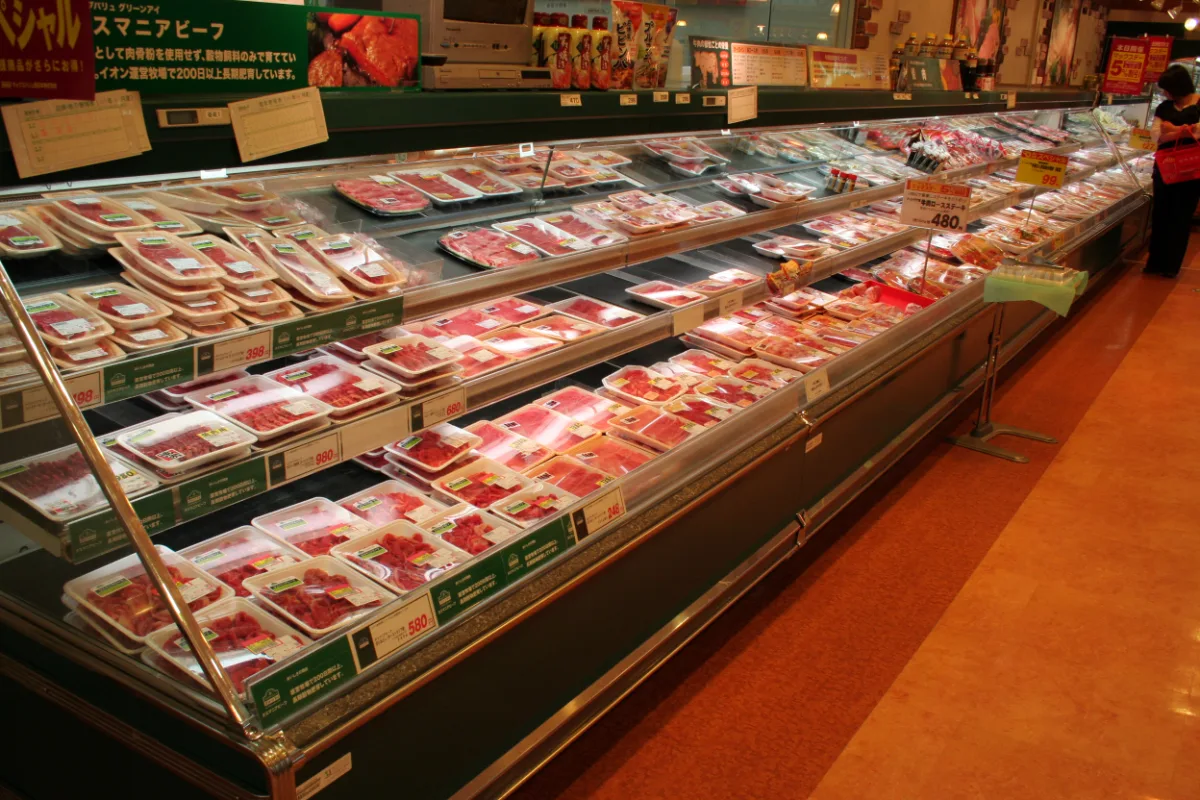
Supermarkets & Food Retail in Japan
Food is Japan’s largest retail market — ¥55.8 trillion, more than a third of all retail sales — and it is consolidating fast. National chains are finally displacing regional operators, and the top five food retailers already control almost 30% of the market.
How big is Japan’s food retail market?
Food retailing was worth around ¥55.8 trillion in FY2025 — about 35% of all Japanese retail sales, and rising for the first time since 2020. Japan’s 23,264 supermarkets are run by 818 companies, a number that has fallen 17% in just five years even as total store numbers rose by nearly a thousand: the sector is being redistributed from small, independent operators into the portfolios of expanding national chains. Households feel the weight of it too — food now takes 27.2% of household spending (over ¥1.1 million per household last year), a strikingly high ratio against comparable economies, and one that keeps growing as food inflation runs ahead of wages.
Who is winning the consolidation race?
Historically, food distribution was fragmented and regional, constrained by wholesaler relationships. That model is breaking. The five largest food retail operators — Aeon, Seven Eleven, the Mitsubishi-affiliated chains, FamilyMart and Trial — accounted for 29.5% of all food sales in FY2024, and the top 20 held 48%. M&A is accelerating: Trial acquired Seiyu, Yaoko created Blue Zones HD as an acquisition vehicle, and Aeon is consolidating its regional banners. Meanwhile 21.1% of regional and mid-sized supermarket companies were loss-making in 2024, and bankruptcies among regional supermarkets rose 46.6% year on year.
Drugstores are a growing force too: their share of food retail has nearly doubled since 2016, from 3.5% to 6.3%, and Cosmos Yakuhin is now Japan’s ninth-largest food retailer.
Leading operators

Aeon
Japan’s largest food retailer with combined food sales over ¥5.1 trillion across its affiliates — roughly 10.5% of the entire market. Operates more stores in more regions than any rival and is finally consolidating its acquired banners: Fuji in Chugoku/Shikoku, with USMH and Daiei next in Kanto and Kansai. Its TopValu private-brand range is a category benchmark.
Trial Holdings
The sector’s fastest riser — from Kyushu discounter to a top-five national food retailer with close to ¥1 trillion in food sales after acquiring Seiyu. A technology-led discounter: smart shopping carts, retail media, and aggressive everyday-low-price positioning aimed squarely at inflation-squeezed households.
Lopia (OIC Group)
Originally a meat-focused discounter from Kanagawa, Lopia is pursuing one of the most aggressive organic expansions in Japanese retail — from around 100 to 143 stores across 22 prefectures (plus Taiwan) in the year to December 2025, with a target of 300 stores by FY2031. Shoppers increasingly treat a Lopia visit as a destination trip.
What’s reshaping the sector?
- Private brands have gone mainstream — PB share of processed food reached 16.8%, the highest since tracking began, and around 80% of supermarket shoppers now buy PB regularly. The PB packaged-food market of roughly ¥2.6 trillion is projected to exceed ¥3.5 trillion by 2030.
- Deli is displacing home cooking — the ready-made meal market hit ¥11.29 trillion, with supermarkets the standout channel (up 23.5% on 2019). Deli gross margins of around 49% (against under 30% for fresh) are pulling floor space and investment away from raw staples; half of stores are now serviced by central processing centres.
- The food-access crisis — over 9 million seniors live 500m or more from a food store. A third of chains now run mobile shops, and the industry is lobbying for supermarkets to be recognised as essential social infrastructure.
- Value rules — shoppers visit fewer stores as EDLP operators gain share; over 80% use self-checkout, but only 25% shop for food online regularly — the sector’s biggest untapped channel.
The full analysis: Japanese Food Retail
JapanConsuming’s food retail coverage is the complete dataset and analysis behind this overview — market sizing, the consolidation race, private brand, deli and ready-meal trends, and consumer survey data. All reports are available to Enterprise subscribers of JapanConsuming.
In the report
- Complete ranking of Japan’s 45 leading food retailers with affiliations and market share
- Food sales by format channel, 2016–2025
- Private brand, deli and ready-meal market analysis
- NSAJ consumer survey data: shopping frequency, store choice, self-checkout, online
- The food-access crisis and the regional supermarket squeeze