Home Centres in Japan
Home centres are Japan’s closest equivalent to DIY and home improvement stores — a ¥4 trillion format that is much more than just DIY, spanning hardware, gardening, pets, household goods and professional trade supplies. Growth is muted and competition comes from all sides, but the biggest chains keep pulling away.
What is a Japanese home centre?
A home centre is a large, mainly non-food general merchandise store anchored in DIY, home improvement and home-related categories — hardware, tools, building materials, gardening, pets, storage and interiors, often with services for tradespeople. The format arrived in 1972 as American-style roadside stores with large car parks, riding Japan’s late shift to motorisation. Today METI classifies “home improvement stores” as a distinct format, and the Japan DIY-HC Association counts 44 member companies running around 4,500 outlets.
How big is the market?
The home centre market reached ¥4.05 trillion in FY2024 — its first increase in four years, after a one-off Covid boom (¥4.27 trillion in FY2020) and three years of correction. Store numbers passed 5,000 for the first time, but net additions have slowed to around 40–50 a year and sales per store have drifted from about ¥810 million (2014) to the mid-¥700 millions: a saturated landscape where physical expansion no longer yields proportional revenue. Kanto alone generates more than 40% of national sales.
Who leads the sector?
The sector is geographically fragmented — several regional players dominate their home markets — but increasingly concentrated by revenue: the top ten chains hold about 72% of sales and the top five roughly 60%, with the leading seven holding first place in 36 of Japan’s 47 prefectures. M&A is now a core strategy for every major player — DCM has integrated Keiyo and plans to acquire Encho — and further consolidation looks inevitable.

Cainz
Market leader with a 14.9% share. The sector’s private-brand benchmark, known for design-led own-label ranges, and an innovator in new sub-formats — including compact urban stores targeting single-person households — backed by heavy investment in digital and logistics.
DCM Holdings
A 14.1% share built through consolidation — the group is an amalgam of regional chains, most recently integrating Keiyo with Encho to follow. Expanding pro-oriented banners for tradespeople and pushing into online, including the acquisition of e-commerce retailer X-Price.

Kohnan Shoji
Third with a 13.0% share, centred on Kansai. The most aggressive developer of professional-format stores — the sector’s most dynamic sub-format — serving contractors and trades alongside its consumer business.
Where is the format heading?
- From scrap-and-build to renovation — Japan’s housing culture is shifting toward maintenance and partial renovation, repositioning home centres as infrastructure for domestic upkeep rather than simple hardware sellers.
- Pro and specialist formats are the main growth engine, with Kohnan and DCM rolling out trade-focused banners.
- Category shifts — DIY tools and materials remain the largest category (22–23% of sales); pet supplies have grown to nearly 8% with attractive margins; household consumables keep leaking to drugstores.
- Competition from every direction — drugstores and GMS on daily goods, Nitori, IKEA and Muji on interiors, and e-commerce across the board. Online share of the household category is forecast to reach around 40% by 2028.
Home Centres 2026: Much More Than Just DIY
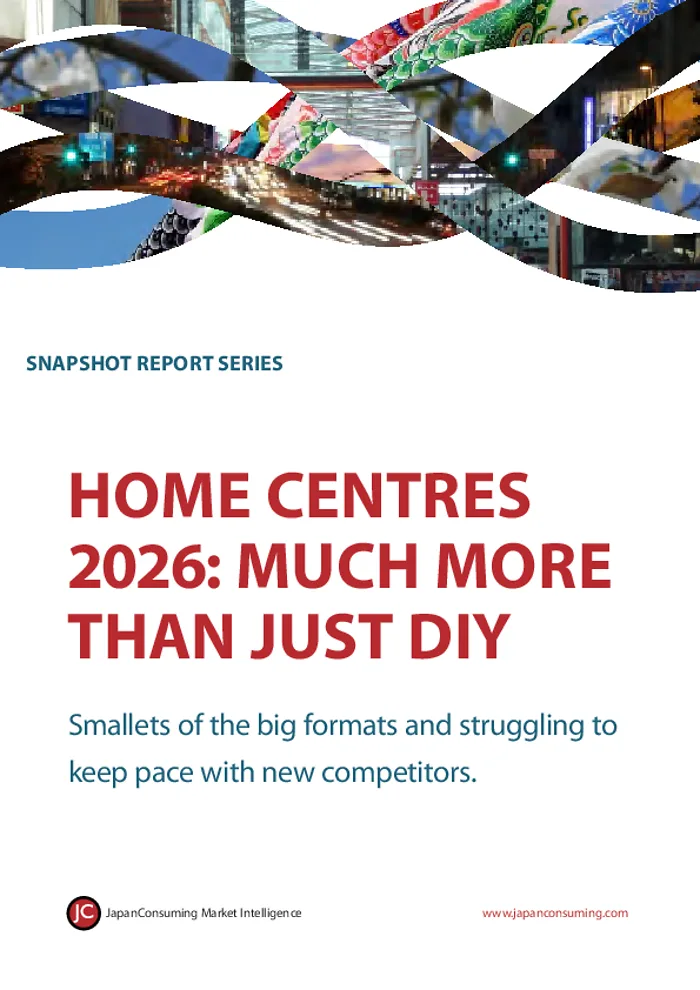
The complete report behind this overview — a strategic view of the ¥4 trillion home centre market with 19 charts and data tables covering market size, category structure, consumer behaviour, operator rankings and regional coverage. All reports are available to Enterprise subscribers of JapanConsuming.
In the report
- Market size and growth, 1993–2025, with sales-per-store trends
- Product category structure and share shifts, 2014–2025
- Consumer behaviour, shopping frequency and key segments
- Sales ranking of the leading 20 operators, with PB share estimates
- Regional coverage: chain-by-chain share in every region